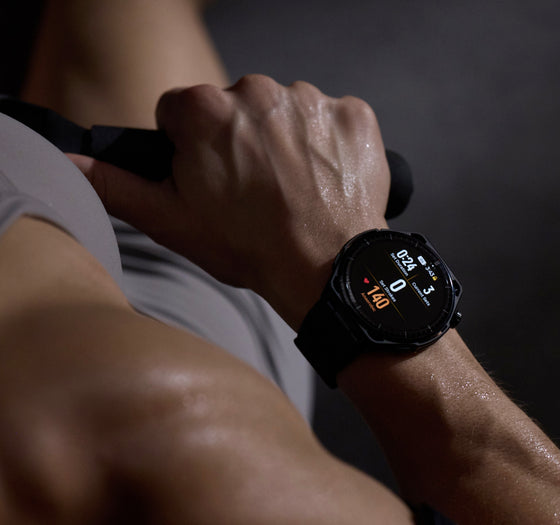
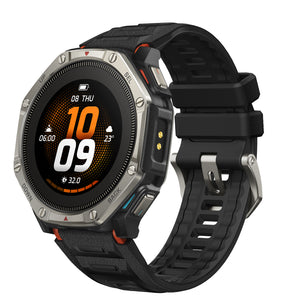
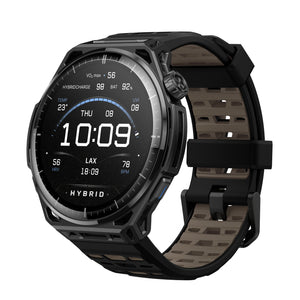

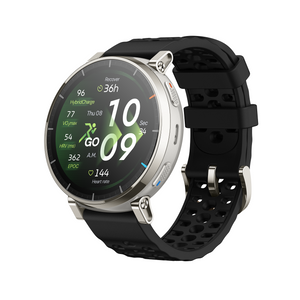
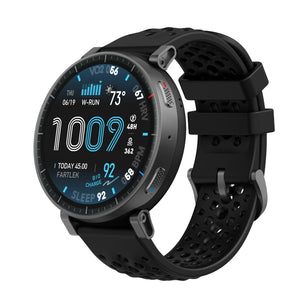
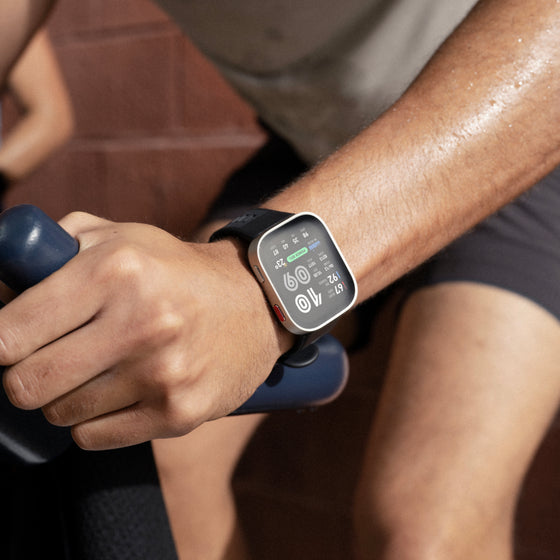
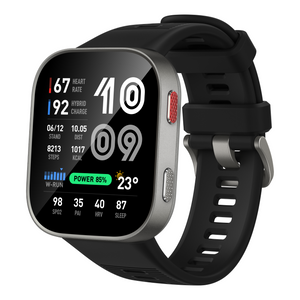
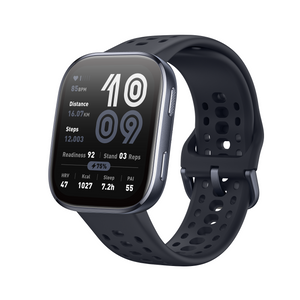

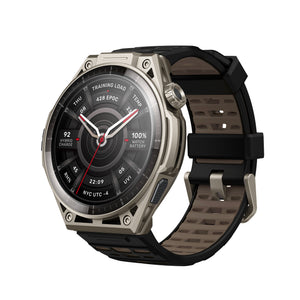
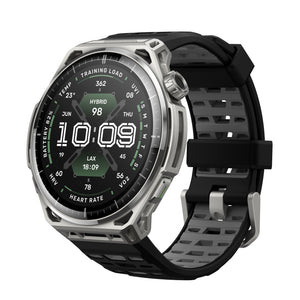
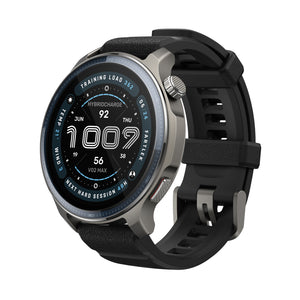

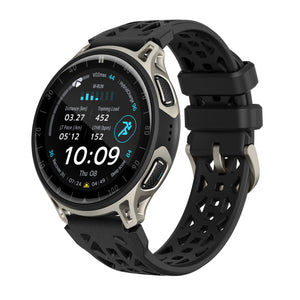
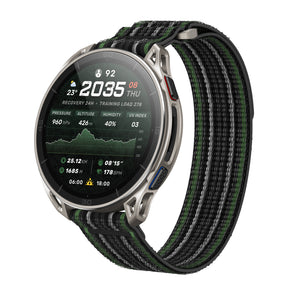
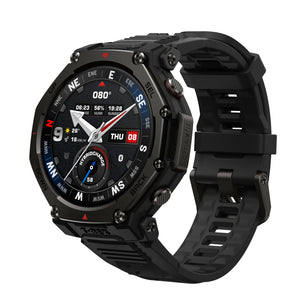
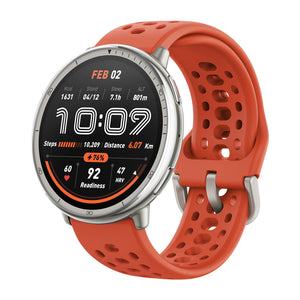


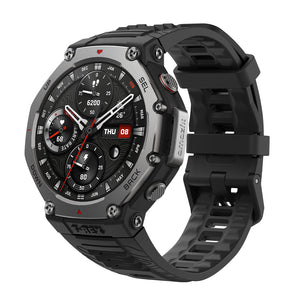
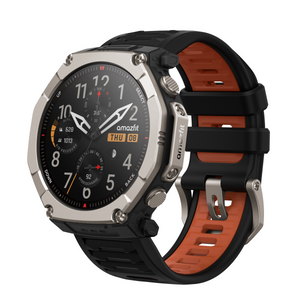




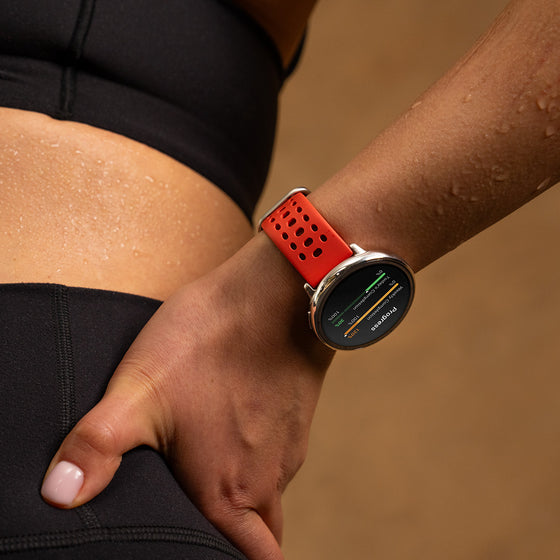







Tracking your runs is just the beginning. Amazfit smartwatches go further by analyzing key metrics like pace, heart rate, VO2 Max, recovery and more to give you a clear picture of your performance and progress. These insights help you understand where you are in your training and what it takes to go even further. If you are seeing the data but want to better understand what it means for your journey, you are in the right place.
-

Running Power
Running power measures the total effort you’re putting into each stride in watts, giving you a real-time, objective view of intensity.
The advantage of power over other metrics is that it responds quickly to changes in effort, is consistent from session to session and takes into account environmental factors like hills and wind.
When you know how much power you’re expending from minute to minute and mile to mile, it’s easier to pace yourself, which can keep you from tiring out too quickly.
Think of your body’s energy as the battery of your smartphone. You can turn up the screen’s brightness all the way, but, as a result, the battery won’t last as long. Or you can conserve battery by dimming the screen and getting a longer battery life. Likewise, by knowing your body and its power output while running in different conditions, you can monitor this data to conserve your energy. For marathons and other long-distance runs, this can help you fine-tune your training and performance on race day
-

Lactate Threshold
Lactate threshold represents the intensity at which lactate begins to accumulate in the bloodstream faster than the body can clear it. Contrary to common belief, lactate itself is not the problem. It is a usable energy source. The challenge occurs when production outpaces clearance, leading to a rapid rise in acidity within the muscles and a breakdown in efficiency.
For runners, this threshold marks the upper limit of sustainable performance. Below it, the body can maintain a steady state. Above it, fatigue accelerates quickly. The higher your lactate threshold, the faster you can run while remaining in control.
Training to improve this system is one of the most effective ways to build endurance. Structured efforts near threshold intensity stimulate adaptations in mitochondrial density, capillary development, and lactate transport, allowing the body to process and reuse lactate more efficiently over time.
By tracking lactate threshold in real time, runners gain a precise understanding of their optimal training zones. It becomes possible to target the exact intensity that drives adaptation without unnecessary fatigue, refine pacing strategies for sustained efforts, and measure how the body is improving across training cycles.The result is not just faster running, but more controlled, repeatable performance. Effort becomes more efficient, fatigue becomes more manageable, and progress becomes measurable through disciplined training. -

Ground Contact Time
Ground contact time tracks how long your foot stays on the ground with each step. By monitoring the balance between your left and right foot ground contact time in milliseconds, you can measure the symmetry as you run. Tracking this metrics helps identify inefficiencies and imbalances in your stride, refine your technique, and reduce injury risk, all while building a faster, more efficient running form.
-

Vertical Oscillation
Vertical oscillation measures how much your body moves up and down with each stride, expressed as the vertical distance traveled at the torso. It reflects how efficiently energy is directed forward rather than lost in upward motion. It's the cost-to-benefit relationship of moving forward.
Lower vertical oscillation is generally associated with more economical running, as less energy is wasted. More experienced runners often demonstrate lower values, though oscillation may increase at higher speeds as stride mechanics change.
Monitoring vertical oscillation, alongside cadence and ground contact time, helps refine running form, improve efficiency, and support more consistent performance over time. -

Heart Rate Monitoring
Heart rate (HR), measured in beats per minute (bpm), is one of the most widely used indicators for understanding how your body is responding—whether you're pushing through a workout or recovering after one.
A higher-than-usual HR at rest, or a lower-than-expected HR during downtime, can signal that something's off. That's why Amazfit watches give you real time heart monitoring and customizable alerts, so you can stay in tune with your body and take action when it matters most. -

VO₂ Max
Maximal oxygen uptake (VO₂ Max) refers to the maximum amount of oxygen an individual can consume per unit of body weight during intense physical activity over a given period. It is a key indicator of aerobic capacity—higher values reflect greater cardiovascular fitness.
Amazfit devices estimate your VO₂ Max during flat terrain runs at low altitude by analyzing personal information and workout data such as heart rate, speed, and elevation. This estimation provides a helpful assessment of your aerobic fitness level. -

Resting Heart Rate (RHR)
Your sleep Resting Heart Rate (RHR) is the number of times your heart beats per minute while you're asleep. Generally, a lower RHR indicates better overall health, as it suggests your heart is functioning efficiently and your body is well-recovered. A lower RHR can also help your body handle more intense physical activity, such as high intensity exercise.
However, a very low or very high RHR may be a sign of underlying issues such as illness, stress, anxiety, or lifestyle factors like caffeine intake, changes in exercise habits, or irregular sleep patterns. If your RHR is unusually low or high, monitor for symptoms like dizziness, shortness of breath, or fatigue—and be sure to rest when needed. -

Recovery Time
Total recovery time is the recommended duration your body needs to fully recover after a workout. Based on your most recent heart rate data, the device provides personalized recovery suggestions to help you rest effectively and plan your next session—minimizing the risk of injury.
0–18 hours: You are fully or nearly fully recovered and can begin slightly higher-intensity training.
19–35 hours: You’re ready to resume training and can gradually ramp up your regimen.
36–53 hours: Lowering your workout intensity will help your body absorb the benefits of your last session. Prioritize recovery activities to reduce fatigue.
54–96 hours: Allow ample rest to maximize gains from your previous high-intensity training.
-
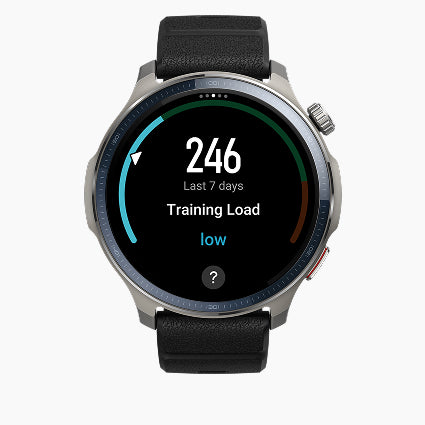
Training Load
After each workout, we calculate your single workout load based on your EPOC (excess post-exercise oxygen consumption). The longer and more intense the session, the higher your score.Your Training Load is then calculated from the sum of all single loads over the past 7 days, providing insight into how much recent exercise has taxed your body.
If the value is too low, it may not significantly improve your fitness.
If it’s too high, your body may become overly fatigued—limiting progress and increasing the risk of injury.
To build fitness effectively while staying within your body’s limits, we recommend keeping your Training Load within the moderate range, which is tailored based on your recent and long-term exercise data. The more you train, the more accurate this range becomes. -
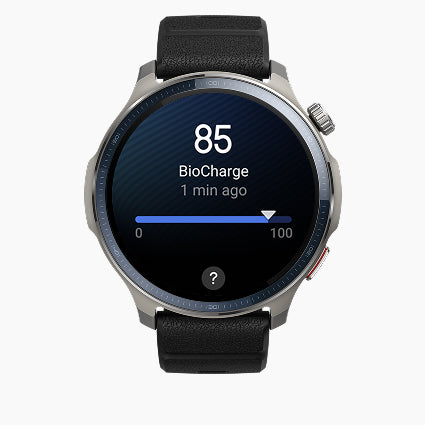
BioCharge Energy Monitoring
BioCharge is a personalized body energy management feature that continuously analyzes your energy levels by integrating data from your nighttime sleep, daytime naps, exertion, and stress indicators.
Your BioCharge score ranges from 0 to 100, typically reaching its peak upon waking in the morning after a full night’s sleep. As you go through the day, activities like exercise, work, and emotional stress gradually deplete your BioCharge. However, short naps or moments of relaxation can help replenish it. For the most accurate insights, it's recommended to wear your device throughout the day.
BioCharge helps you better manage your exercise routine by showing when your body is primed for activity or needs recovery. A high score indicates that you have enough energy to take on a workout, while a low score suggests that rest might be more beneficial. -
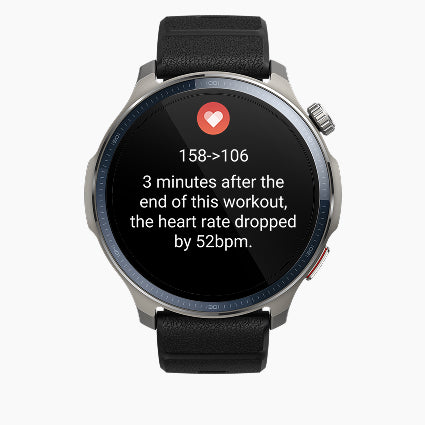
Post-workout Heart Rate (Recovery)
Post-workout heart rate recovery (HRR) is a key fitness indicator that measures how quickly your heart rate drops after exercise. It reflects the efficiency of your cardiovascular system and your body’s ability to return to a resting state after exertion. After you complete a workout, your Amazfit watch tracks how much your heart rate decreases in the first 1 to 2 minutes of rest.
For example:1-minute HRR = Heart rate at end of workout − Heart rate after 1 minute
2-minute HRR = Heart rate at end of workout − Heart rate after 2 minutes
This data is typically displayed on screen or in the Zepp App immediately after your session.A drop of 12 bpm or more after 1 minute is generally a sign of good heart health.
A drop of 22 bpm or more after 2 minutes is even better.
Slower recovery could indicate fatigue, overtraining, or lower fitness levels.
A high HRR means you are well conditioned and your parasympathetic nervous system (responsible for rest and recovery) is responding efficiently. A lower HRR may suggest incomplete recovery, elevated stress, or a need for additional rest before your next intense workout. -
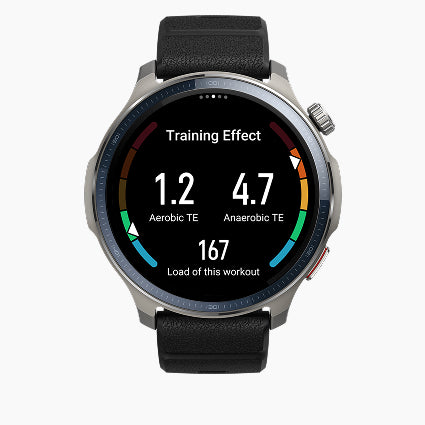
Training Effect
Training Effect (TE) is a metric that measures how effectively a workout improves your aerobic and anaerobic fitness. While wearing your device, the TE score starts at 0.0 and increases as your workout progresses, ranging from 0.0 to 5.0. A higher TE score reflects greater intensity and potential training benefits, but a score of 5.0 may also indicate a high body load that requires extra recovery—especially for non-athletes.
Aerobic Training Effect
The aerobic TE score reflects how well a workout improves your cardiovascular endurance and VO₂ Max. It's calculated based on your heart rate and speed during exercise.0.0–0.9: No improvement in aerobic capacity
1.0–1.9: Minor improvement; ideal for recovery
2.0–2.9: Maintains current aerobic fitness
3.0–3.9: Significant improvement
4.0–4.9: Strong enhancement of heart and lung function
5.0: Maximum effect; recovery is essential
Anaerobic Training Effect
The anaerobic TE score reflects how much benefit you're getting from high-intensity efforts such as sprinting or interval training.0.0–0.9: No effect on anaerobic capacity
1.0–1.9: Slight improvement
2.0–2.9: Maintains anaerobic fitness
3.0–3.9: Significant gains in anaerobic performance
4.0–4.9: Major improvement
5.0: Peak anaerobic benefit; extended recovery recommended
-
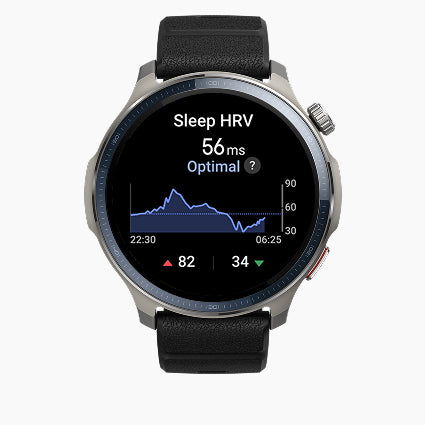
Heart Rate Variability (HRV)
HRV is calculated by measuring the variations in the time intervals between consecutive heartbeats. Amazfit devices measure HRV using the RMSSD method, which stands for the root mean square of successive differences between normal heartbeats. RMSSD primarily reflects how well the autonomic nervous system regulates the body, making it a key indicator of cardiac health, stress levels, and overall well-being.
Your HRV baseline is established using approximately seven days of continuous sleep HRV data. By comparing daily HRV values to this baseline, you can better assess your current health and recovery status.
HRV ranges can vary widely between individuals and are influenced by factors such as age, gender, and overall health. In general, a healthy adult’s HRV may range from 20 ms to 200 ms, with values typically decreasing with age.Higher HRV often indicates good cardiovascular and nervous system adaptability, lower stress levels, and strong recovery capacity.
Lower HRV may signal elevated stress, fatigue, or other health concerns.
Tips to Improve HRV:Engage in regular physical activity
Prioritize high-quality sleep
Practice mindfulness, deep breathing, or yoga
Maintain a balanced diet and limit caffeine and alcohol intake
Note: For the most accurate HRV readings, wear your device properly and remain still during measurement. If the HRV Sleep Timeline appears incomplete, it may indicate movement or improper device placement. This feature is currently available on select Amazfit devices. -
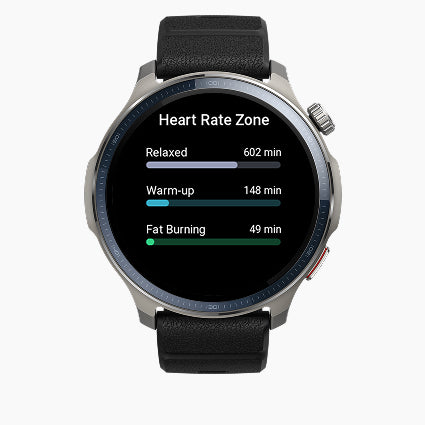
Heart Rate Zones
During every activity, your device automatically tracks your heart rate and classifies the intensity into five heart rate zones, helping you understand how hard you're training and which energy systems you're engaging. These zones are based on your Maximum Heart Rate (HR max), which the watch estimates using your age or a custom value you provide. Alternatively, zones can be calculated using the percentage heart rate reserve method, which factors in both your resting and maximum heart rates stored in your profile settings.
Heart Rate Zones:Zone 1: Light Effort (50–60% of HR max)
Intensity: Very light
Purpose: Warm-up, cooldown, active recovery
Feels like: Easy pace, light breathingZone 2: Fat Burn (60–70% of HR max)
Intensity: Light
Purpose: Improves basic endurance, promotes fat metabolism
Feels like: Sustainable pace, comfortable conversationZone 3: Aerobic (70–80% of HR max)
Intensity: Moderate
Purpose: Builds cardiovascular fitness and endurance
Feels like: Steady effort, deeper breathing, talking becomes difficultZone 4: Anaerobic (80–90% of HR max)
Intensity: Hard
Purpose: Improves speed, power, and VO₂ max
Feels like: High effort, heavy breathing, limited speechZone 5: Maximum Effort (90–100% of HR max)
Intensity: Maximum
Purpose: Peak performance, sprinting, high intensity intervals
Feels like: Short bursts, all-out effort, cannot be sustained for long -
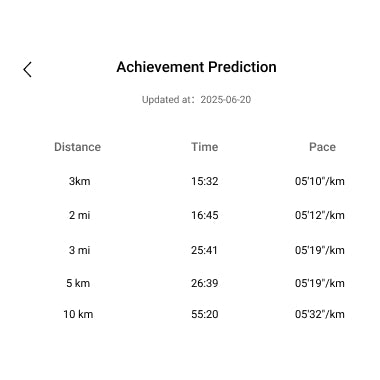
Achievement Prediction
This feature uses your outdoor running history, VO₂ max, and current physical condition to assess your athletic performance and predict race outcomes. Consistent, structured training is essential to improve your predicted results.
Note: You must complete at least one 3K run to receive a performance prediction. -
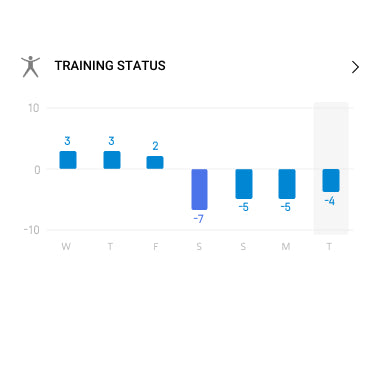
Training Status
Training Status, also known as Training Status Balance (TSB), reflects how well your body is adapting to recent training. It is calculated as the difference between your Fitness Level (CTL) and your Fatigue Level (ATL).
A higher Training Status score means your recent training feels easier. Your Training Status falls into one of five categories: Easy, Energetic, Balanced, Optimal, or Excessive.